
The human eye can focus on objects at different distances thanks to the ciliary muscle.



The ciliary muscle is one of the fastest and most precise muscles in the body! It’s constantly making tiny adjustments so you can see clearly, whether you’re reading a book or spotting a bird in the distance. However, as we age, the lens becomes less flexible, and the ciliary muscle has a harder time focusing on close objects—this is why many people need reading glasses as they get older!
The human eye can see ultraviolet light.
While humans can’t see UV light, some animals can! Bees, butterflies, and certain birds use UV vision to find flowers or navigate. Even more fascinating: some people who’ve had their eye lenses removed (due to cataracts, for example) can see a bit of UV light because the lens normally blocks it!
Dogs and cats can have two eyes that are different colors. This is NOT possible in humans.
Humans can have two eyes that are different colors, a condition called heterochromia. This can happen due to differences in the amount or type of pigment in the iris of each eye. Heterochromia can be present from birth (congenital) or develop later in life due to injury, disease, or certain medical conditions. Heterochromia is rare in humans but more common in some animals, like cats and dogs. For example, you might have seen a cat with one blue eye and one green eye!
The iris of the eye controls the amount of light that enters the eye.

The iris of the eye controls the amount of light that enters by adjusting the size of the pupil. In bright light, the iris makes the pupil smaller to let in less light. In dim light, it makes the pupil larger to let in more light. The iris is what gives your eye its color, like blue, brown, or green. But here’s something cool: no two irises are exactly the same—not even between your left and right eye! This uniqueness is why iris scans are used for high-security identification, like in spy movies!
The human eye can fully recover from a scratched cornea.
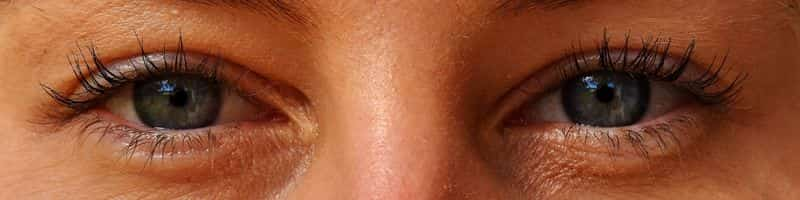
The human eye can often fully recover from a scratched cornea, also known as a corneal abrasion. The cornea is the clear, protective outer layer of the eye, and it has a remarkable ability to heal itself, usually within 24 to 48 hours for minor scratches. However, deeper or more severe scratches may take longer to heal and could require medical treatment.
Advertisement
Under normal conditions, the human eye can see infrared light.
Normally, our eyes can’t see infrared light. We only see a small range of light called the "visible spectrum," which includes colors like red, blue, and green. Infrared light has longer wavelengths than red light, so it’s invisible to us without special tools like night-vision goggles. Even though we can’t see infrared light, we can feel it as heat! Things like the sun or a warm stove give off infrared waves, which is why they feel hot. Cool side note: some animals, like certain snakes, can actually "see" infrared light using special heat-sensing organs, helping them hunt in the dark!
The human eye can see in complete darkness.
While humans can’t see in complete darkness, some animals can! For example, cats, owls, and other nocturnal animals have special adaptations, like a high number of rod cells (which detect low light) or a reflective layer behind the retina called the tapetum lucidum, which helps them see in very dim conditions. Humans, on the other hand, rely on at least a tiny bit of light to see—like moonlight or starlight.
The human eye can adjust to bright light quickly.
This adjustment is called the pupillary light reflex, and it happens almost instantly—in just a fraction of a second! However, if you’ve been in the dark for a while, like in a movie theater, it might take a few moments for your eyes to fully adjust to bright light. This is because your rods (light-sensitive cells in the retina) need time to "reset" after being used in low-light conditions.
The human eye has two lenses.
The human eye has one primary lens that helps focus light onto the retina at the back of the eye. This lens changes shape to adjust focus, allowing us to see objects clearly at different distances—a process called accommodation. While the eye has only one main lens, it’s part of a larger optical system that includes the cornea, which also helps focus light. Interestingly, the lens becomes less flexible as we age, which is why many people need reading glasses later in life. Also, some animals, like birds, have two foveas (areas of sharp vision) in their eyes, giving them super-sharp focus—way better than humans!
The human eye has a built-in mechanism for cleaning itself.
- Tears: Your eyes produce tears to wash away dust, dirt, and other particles. Tears also keep the surface of the eye moist and smooth.
- Blinking: Every time you blink, your eyelids spread tears across the eye and help remove debris.
- Eyelashes: Your eyelashes act like tiny brooms, catching dust and dirt before it can get into your eyes.
Fun fact: Tears aren’t just water—they’re a mix of water, oils, mucus, and special proteins that fight bacteria. Plus, you produce fewer tears as you age, which is why dry eyes are more common in older adults. Also, on average, you blink about 15-20 times per minute, which adds up to over 10,000 blinks a day—that’s a lot of cleaning!
Advertisement
The retina of the eye is responsible for detecting color.
The retina, located at the back of the eye, contains special cells called rods and cones that detect light and color. The cones are responsible for color vision and work best in bright light, while the rods help us see in low light but don’t detect color. Humans typically have three types of cones, each sensitive to different colors: red, green, and blue. This is called trichromatic vision. However, some animals, like mantis shrimp, have up to 16 types of cones, allowing them to see colors we can’t even imagine! On the flip side, many animals, like dogs, have fewer cones and see the world in fewer colors than we do.
The macula is the part of the eye responsible for sharp central vision.
The macula is a small area in the center of the retina that’s responsible for sharp, detailed central vision. It’s what allows you to see fine details, read, recognize faces, and do tasks that require focus. The macula contains a high concentration of cone cells, which are responsible for color vision and detecting fine details.