
The human ear can fully recover from a ruptured eardrum.



A ruptured eardrum can happen due to loud noises, sudden pressure changes (like flying or scuba diving), or even from poking objects like cotton swabs. While it can be painful, the healing process is fascinating—the eardrum essentially patches itself up by growing new tissue. However, in some cases, if the rupture doesn't heal on its own, a minor surgical procedure called a tympanoplasty might be needed to repair it.
The human ear can detect changes in temperature.
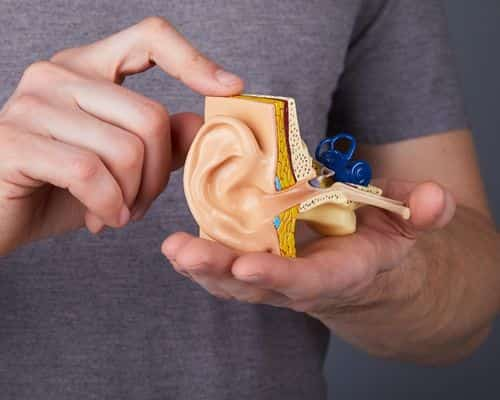
While the ear can't detect temperature, it is incredibly sensitive to pressure changes. The Eustachian tube, which connects the middle ear to the back of the throat, helps equalize pressure—like when your ears "pop" during a flight or a drive up a mountain. Also, the ear's shape (the pinna) helps funnel sound waves into the ear canal, making it easier to hear, but it doesn't play a role in temperature detection!
The human ear can only hear sounds within a certain frequency range.
The human ear can only hear sounds within a specific frequency range, typically between 20 Hz and 20,000 Hz (20 kHz). Sounds below this range are called infrasound, and sounds above it are called ultrasound. As we age, our ability to hear higher frequencies decreases. This is why many adults can't hear the high-pitched "mosquito tone" (around 17-18 kHz) that teenagers often use as ringtones!
Earwax is harmful to the ear.
Earwax, also known as cerumen, is produced by glands in the ear canal. It is not harmful to the ear and it serves to protect the ear by trapping dirt and other particles and preventing them from reaching the eardrum.
The human ear can heal itself from damage caused by loud noises.
The human ear cannot fully heal itself from damage caused by loud noises, especially when it comes to the delicate hair cells in the cochlea. Once these hair cells are damaged or destroyed, they do not regenerate, leading to permanent hearing loss. While the ear can't repair damaged hair cells, researchers are exploring ways to regenerate them using stem cells and other advanced technologies. In the meantime, protecting your ears from loud noises (like concerts, machinery, or even headphones turned up too high) is the best way to preserve your hearing!
Advertisement
The human ear can detect ultrasound.

The human ear can only detect sounds within a certain frequency range, and ultrasound is a type of sound that is above the upper limit of human hearing.
The human ear is responsible for both hearing and balance.
The tiny hair cells in your inner ear that help you hear are so sensitive that they can detect movements as small as the width of an atom! Also, the balance system in your inner ear uses fluid-filled canals and tiny crystals to help you stay upright—this is why spinning in circles can make you dizzy, as it temporarily disrupts that fluid!
The vestibular system is responsible for maintaining balance.
The vestibular system, located in the inner ear, is responsible for maintaining balance and spatial orientation. It helps you sense motion, head position, and gravity, which are essential for coordination and stability.
The human ear can detect a wider range of sounds than any other animal.
While humans can typically hear between 20 Hz and 20,000 Hz, the greater wax moth holds the record for the highest known hearing range of any animal—it can detect frequencies up to 300,000 Hz! This helps it avoid predators like bats. On the other hand, elephants can hear infrasound (sounds below 20 Hz), which they use to communicate over long distances. So, while humans have a decent hearing range, many animals have us beat!
The human ear can detect changes in pressure.
The human ear has a structure called the eustachian tube, which connects the middle ear to the back of the throat. The eustachian tube helps to equalize pressure between the middle ear and the outside environment, allowing the ear to detect changes in pressure less than one billionth of atmospheric pressure.
Advertisement
The cochlea is responsible for detecting vibrations in the air.
The cochlea is not responsible for detecting vibrations in the air directly. Instead, it detects fluid vibrations that are transmitted from the middle ear. The cochlea is shaped like a snail shell and is only about the size of a pea, but it contains around 16,000 tiny hair cells that are essential for hearing. Once these hair cells are damaged, they cannot regenerate, which is why loud noises can cause permanent hearing loss!
The eardrum is responsible for amplifying sound waves.
The eardrum (tympanic membrane) does not amplify sound waves. Instead, it vibrates in response to sound waves and transmits those vibrations to the tiny bones in the middle ear (the ossicles), which then amplify the sound.